2020 United States elections
Elections were held in the United States on November 3, 2020. The Democratic Party's nominee, former vice president Joe Biden, defeated incumbent Republican president Donald Trump in the presidential election. Despite losing seats in the House of Representatives, Democrats retained control of the House and very narrowly gained control of the Senate. As a result, the Democrats obtained a government trifecta, the first time since the elections in 2008 that the party gained unified control of Congress and the presidency. With Trump losing his bid for re-election, he became the first president to have seen his party lose the presidency and control of both the House and the Senate in a single term since Herbert Hoover in 1932. This was the first time since 1980 that either chamber of Congress flipped partisan control in a presidential year, and the first time Democrats did so since 1948.
Biden became his party's nominee after defeating numerous challengers in the Democratic primaries, while Trump faced token opposition in the Republican primaries. In the congressional elections, Democrats lost seats in the House of Representatives but retained their majority in the chamber by a narrow margin. Democrats made a net gain of three seats in the Senate for a total of 50 seats, taking control of the chamber as newly elected vice-president Kamala Harris could cast tie-breaking votes. Contests for the six non-voting congressional delegates from the District of Columbia and the permanently inhabited U.S. territories were also held during the 2020 elections.
Regularly scheduled elections were held in 86 of the 99 state legislative chambers, and 11 states held their gubernatorial elections. Only one state governorship and two legislative chambers changed partisan control, as Republicans won the gubernatorial race in Montana and gained control of both legislative chambers in New Hampshire. Various other state executive and judicial elections, as well as numerous referendums, tribal elections, mayoral elections, and other local elections, also took place in 2020. The 2020 elections were the last major set of elections to impact the redistricting cycle that will take place following the 2020 census. Significant issues for voters included the ongoing COVID-19 pandemic, as well as health care, the economy, racial unrest and climate change. Social distancing guidelines resulted in unprecedented levels of postal voting and early voting. Voter turnout greatly exceeded recent elections; one projection has turnout by voting eligible population being higher than any election since 1900.
After Biden won the election, Trump and other Republicans refused to concede, making baseless and disproven claims of widespread voter fraud, despite U.S. election security officials saying that the election was "the most secure in American history". These attempts to overturn the election resulted in a deadly attack on the U.S. Capitol, which led to Trump being impeached for the second time and deplatformed across several major social media platforms.
Issues
During the campaign, the most prominent issues were the ongoing COVID-19 pandemic, health care, economy, race, and abortion. Democrats emphasized COVID-19 economic relief and public health measures such as contact tracing, face mask usage, and social distancing, whereas Republicans downplayed COVID-19, scuttled coronavirus economic relief negotiations in the lead-up to the election, and advocated for laxer public health measures to deal with the spread of COVID-19. Trump himself held events across the country, including in COVID-19 hotspots, where attendees did not wear masks and were not socially distancing; at the same time, he mocked those who wore face masks.
The Republican Party opted not to provide a comprehensive platform of its policy positions for the election; the 2020 platform was a one-page resolution which stated that the party "has and will continue to enthusiastically support the president's America-first agenda." Democrats ran on protecting and expanding the Affordable Care Act, while criticizing Republicans for jeopardizing protections for individuals with preexisting conditions. Republicans generally did not emphasize health care issues, as their opposition to the Affordable Care Act had become a political liability by 2020, as the legislation had grown in popularity.
On the environment, Democrats proposed plans to combat climate change, including through investments in renewable energy and rejoining the Paris Climate Accords, whereas Republicans emphasized increased production of oil and natural gas.
During the election campaign, Democrats made calls for criminal justice reform and spoke of a need to reduce systemic racism in the criminal justice system. Republicans ran on a "law and order" and pro-police messaging. While Democrats in many races were moderate, Republicans depicted them as extremists or secret "socialists" who held radical views on criminal justice or climate legislation.
The rhetoric of incumbent president Donald Trump and his allies during the election campaign was marked by frequent use of falsehoods and promotion of unfounded conspiracy theories. In the lead-up to the elections, Republicans attacked voting rights and spread falsehoods about voter fraud. Trump refused to commit to a peaceful transition of power in case he lost the election. While senior Republicans disapproved of Trump's rhetoric in private, they refused to rebuke him publicly.
Federal elections
Presidential election
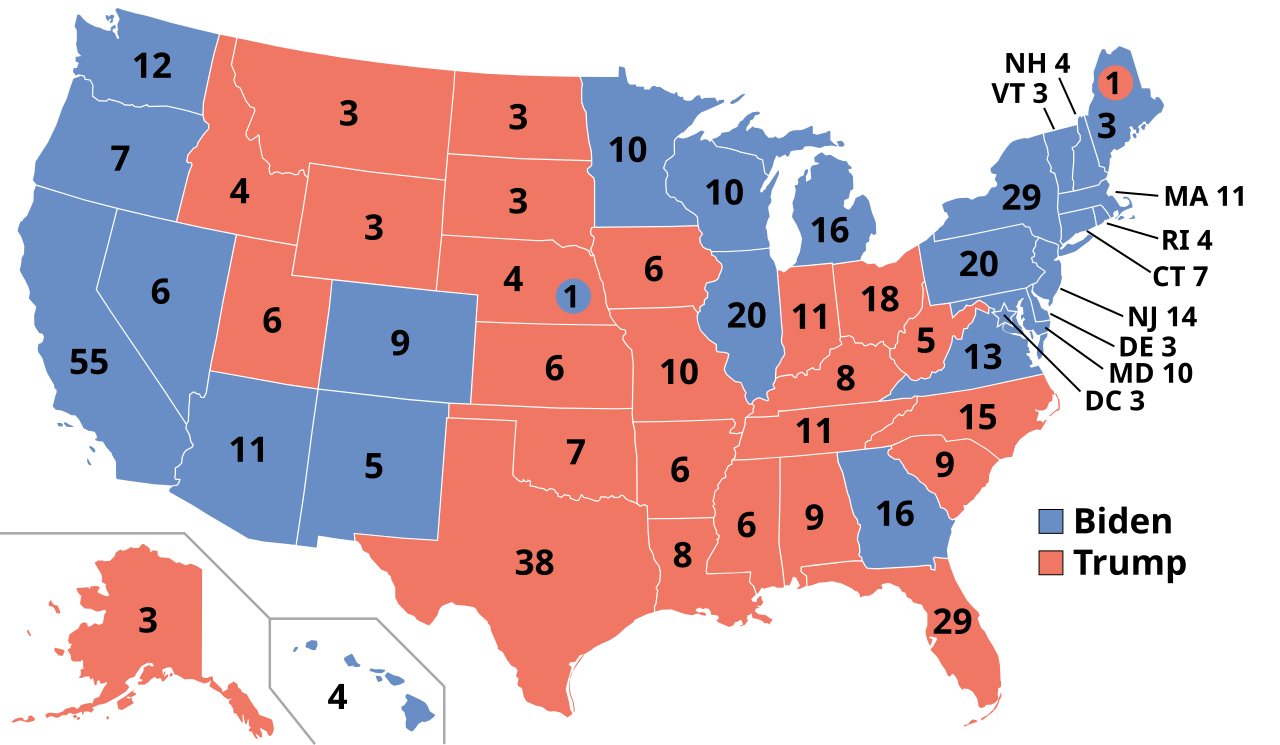
The U.S. presidential election of 2020 was the 59th quadrennial U.S. presidential election, and was held to fill a term lasting from January 20, 2021, to January 20, 2025. By November 7, all major media organizations had projected that former vice president Joe Biden, the candidate of the Democratic Party, had defeated incumbent Republican president Donald Trump in the election. Based on the winner of the popular vote in each state, the Electoral College cast votes on December 14, and Congress counted the electoral votes and formally declared Biden as the election winner in a joint session on January 6, 2021. In the months after the election, Trump challenged the results of the election, but on January 7, following congressional certification of the electoral vote and the 2021 storming of the United States Capitol, Trump acknowledged that "a new administration will be inaugurated."
Biden won the election with 306 electoral votes and 51.3% of the national popular vote, compared to Trump's 232 electoral votes and 46.8% of the popular vote. Biden won every state that 2016 Democratic presidential nominee Hillary Clinton won in the 2016 presidential election, as well as Arizona, Georgia, Michigan, Pennsylvania, Wisconsin, and Nebraska's second congressional district. Biden won the tipping-point state, Wisconsin, by a margin of 0.6%. While Biden won the popular vote by 7 million votes, across Arizona, Georgia, and Wisconsin, the three states whose electoral votes contributed to Biden's win, Biden won by fewer than 45,000 votes. In California and New York, Biden received 7 million more votes than Trump, accounting for Biden's popular vote win. Among third party and independent candidates, Libertarian Party candidate Jo Jorgensen won 1.2% of the popular vote, Green Party candidate Howie Hawkins finished with 0.3% of the vote, and various other candidates won about 0.4% of the vote.
Incumbent Trump won re-nomination by his party after facing token opposition in the 2020 Republican primaries. The Republican Party also re-nominated Vice President Mike Pence as Trump's running mate for the 2020 election. Biden became the Democratic Party's presumptive nominee in early April 2020 after Bernie Sanders withdrew from the 2020 Democratic Party presidential primaries; Biden later chose Kamala Harris as his running mate shortly before the 2020 Democratic National Convention. Along with Biden and Sanders, Elizabeth Warren, Michael Bloomberg, Pete Buttigieg, Amy Klobuchar, and Tulsi Gabbard all won at least one delegate in the 2020 Democratic presidential primaries. Beyond the two major parties, about 1,200 individuals listed their names with the federal government as third party and independent candidates.
Content sourced from Wikipedia under CC BY-SA 4.0


