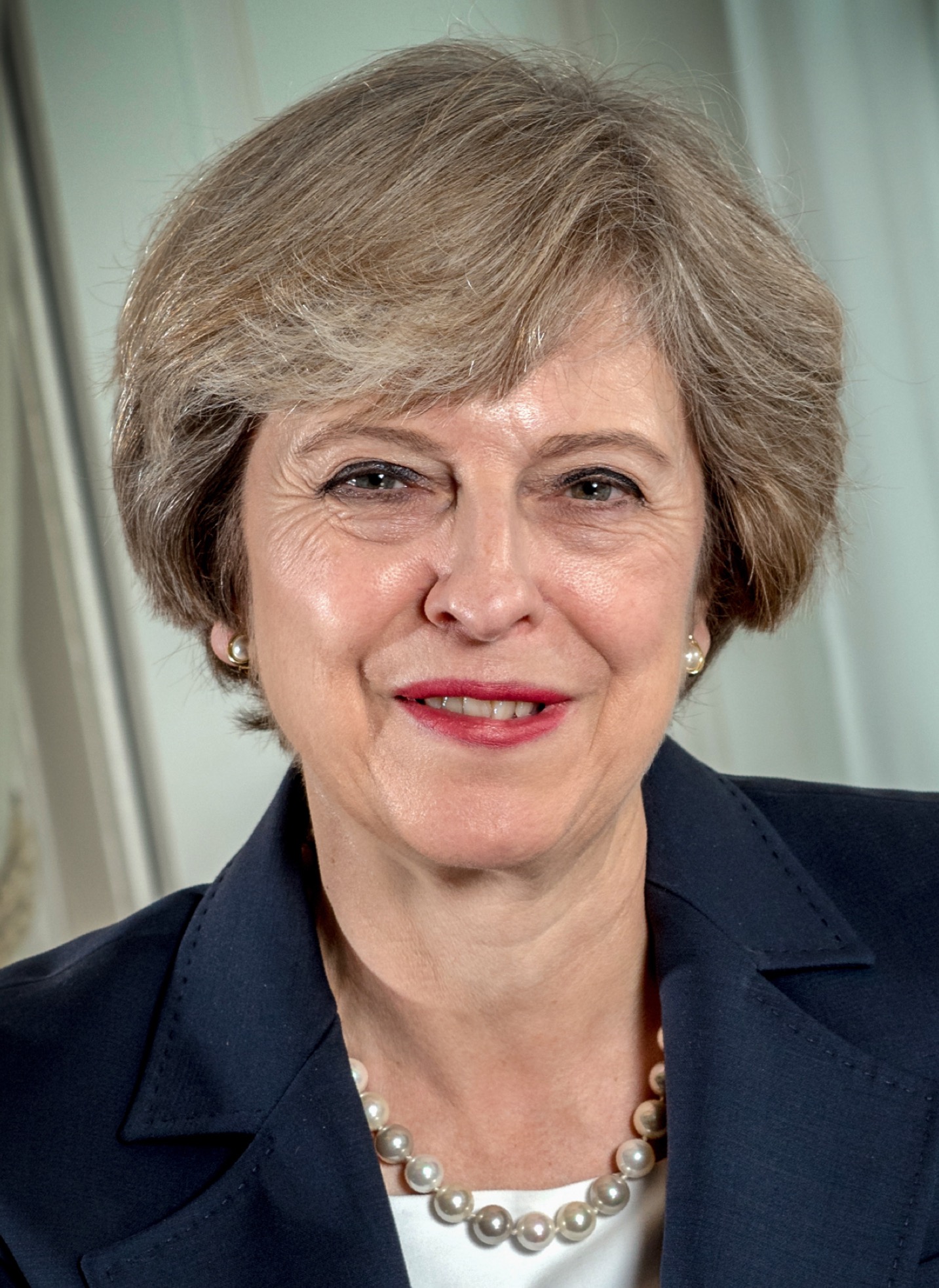
2017 United Kingdom general election
A general election was held in the United Kingdom on 8 June 2017, two years after the previous general election in 2015; it was the first since 1992 to be held on a day that did not coincide with any local elections. The governing Conservative Party led by Prime Minister Theresa May remained the largest single party in the House of Commons but lost its small overall majority, resulting in the formation of a Conservative minority government with a confidence and supply agreement with the Democratic Unionist Party (DUP) of Northern Ireland.
The Conservative Party, which had governed as a senior coalition partner from 2010 and as a single-party majority government from 2015, was led by May as prime minister. It was defending a working majority of 17 seats against the opposition Labour Party led by Jeremy Corbyn. It was the first general election to be contested by either May or Corbyn as party leader; May had succeeded David Cameron following his resignation as prime minister the previous summer, while Corbyn had succeeded Ed Miliband after he resigned following Labour's failure to win the general election two years earlier.
Under the Fixed-term Parliaments Act 2011 an election had not been due until May 2020, but Prime Minister May's call for a snap election was ratified by the necessary two-thirds vote in the House of Commons on 19 April 2017. May said that she hoped to secure a larger majority to "strengthen [her] hand" in the forthcoming Brexit negotiations.
Opinion polls had consistently shown strong leads for the Conservatives over Labour. From a 21-point lead, the Conservatives' lead began to diminish in the final weeks of the campaign. The Conservative Party returned 317 MPs—a net loss of 13 seats relative to 2015—despite winning 42.4% of the vote (its highest share of the vote since 1983), whereas the Labour Party made a net gain of 30 seats with 40.0% (its highest vote share since 2001 and its highest increase in vote share between two general elections since 1945). It was the first election since 1997 in which the Conservatives made a net loss of seats or Labour a net gain of seats. The election had the closest result between the two major parties since February 1974 and resulted in their highest combined vote share since 1970. The Scottish National Party (SNP) and the Liberal Democrats, the third- and fourth-largest parties, both lost vote share; media coverage characterised the result as a return to two-party politics. The SNP, which had won 56 of the 59 Scottish seats at the previous general election in 2015, lost 21. The Liberal Democrats made a net gain of four seats. UKIP, the third-largest party in 2015 by number of votes, saw its share of the vote reduced from 12.6% to 1.8% and lost its only seat, Clacton.
In Wales, Plaid Cymru gained one seat, giving it a total of four seats. The Green Party retained its sole seat, but its share of the vote declined. In Northern Ireland, the DUP won 10 seats, Sinn Féin won seven, and Independent Unionist Sylvia Hermon retained her seat. The Social Democratic and Labour Party (SDLP) and Ulster Unionist Party (UUP) lost all their seats.
Negotiation positions following the UK's invocation of Article 50 of the Treaty on European Union in March 2017 to leave the EU were expected to feature significantly in the campaign, but did not as domestic issues took precedence instead. The campaign was interrupted by two major terrorist attacks: Manchester and London Bridge; thus, national security became a prominent issue in its final weeks.
The outcome of the election would have significant implications for the Brexit negotiations, and led the Parliament of the United Kingdom into a period of protracted deadlock which would eventually bring about the end of May's ministry, and the election of Boris Johnson as Prime Minister, who would go on to call another general election two and a half years later.
Electoral system
Each parliamentary constituency of the United Kingdom elects one MP to the House of Commons using first-past-the-post voting. If one party obtains a majority of seats, then that party is entitled to form the Government, with its leader as Prime Minister. If the election results in no single party having a majority, there is a hung parliament. In this case, the options for forming the Government are either a minority government or a coalition.
The Sixth Periodic Review of Westminster constituencies was not due to report until 2018, and therefore this general election took place under existing boundaries, enabling direct comparisons with the results by constituency in 2015.
Voting eligibility
To vote in the general election, one had to be:
- on the Electoral Register;
- aged 18 or over on polling day;
- a British, Irish or Commonwealth citizen;
- a resident at an address in the UK (or a British citizen living abroad who has been registered to vote in the UK in the last 15 years), and;
- not legally excluded from voting (for example, a convicted person detained in prison or a mental hospital, or unlawfully at large if he/she would otherwise have been detained, or a person found guilty of certain corrupt or illegal practices) or disqualified from voting (peers sitting in the House of Lords).
Individuals had to be registered to vote by midnight twelve working days before polling day (22 May). Anyone who qualified as an anonymous elector had until midnight on 31 May to register. A person who has two homes (such as a university student with a term-time address but lives at home during holidays) may be registered to vote at both addresses, as long as they are not in the same electoral area, but can vote in only one constituency at the general election.
On 18 May, The Independent reported that more than 1.1 million people between 18 and 35 had registered to vote since the election was announced on 18 April. Of those, 591,730 were under the age of 25.
Date and cost of the election
The Fixed-term Parliaments Act 2011 introduced fixed-term Parliaments to the United Kingdom, with elections scheduled every five years since the general election on 7 May 2015. This removed the power of the Prime Minister, using the royal prerogative, to dissolve Parliament before its five-year maximum length. The Act permitted early dissolution if the House of Commons voted by a supermajority of two-thirds of the entire membership of the House.
On 18 April 2017, Prime Minister Theresa May announced she would seek an election on 8 June, despite previously ruling out an early election. A House of Commons motion to allow this was passed on 19 April, with 522 votes for and 13 against, a majority of 509. The motion was supported by the Conservatives, Labour, the Liberal Democrats and the Greens, while the SNP abstained. Nine Labour MPs, one SDLP MP and three independents (Sylvia Hermon and two former SNP MPs, Natalie McGarry and Michelle Thomson) voted against the motion.
Labour leader Jeremy Corbyn supported the early election, as did Liberal Democrat leader Tim Farron and the Green Party. The SNP stated that it was in favour of fixed-term parliaments, and would abstain in the House of Commons vote. UKIP leader Paul Nuttall and First Minister of Wales Carwyn Jones criticised May for being opportunistic in the timing of the election, motivated by the then strong position of the Conservative Party in the opinion polls.
On 25 April, the election date was confirmed as 8 June, with dissolution on 3 May. The government announced that it intended for the next parliament to assemble on 13 June, with the state opening on 19 June.
Timetable
The key dates are listed below (all times are BST):
Cost
The cost of organising the election was around £140 million – slightly less than the EU referendum, of which £98 million was spent on administrative costs, and £42.5 million was spent on campaign costs.
Parties and candidates
Most candidates were representatives of a political party registered with the Electoral Commission. Candidates not belonging to a registered party could use an "independent" label, or no label at all.
The leader of the party commanding a majority of support in the House of Commons is the person who is called on by the monarch to form a government as Prime Minister, while the leader of the largest party not in government becomes the Leader of the Opposition. Other parties also form shadow ministerial teams. The leaders of the SNP, Plaid Cymru and the DUP are not MPs; hence, they appoint separate leaders in the House of Commons.
Great Britain
The Conservative Party and the Labour Party have been the two biggest parties since 1922, and have supplied all Prime Ministers since 1922. Both parties changed their leader after the 2015 election. David Cameron, who had been the leader of the Conservative Party since 2005 and Prime Minister since 2010, was replaced in July 2016 by Theresa May following the referendum on the United Kingdom's membership of the European Union. Jeremy Corbyn replaced Ed Miliband as Leader of the Labour Party and Leader of the Opposition in September 2015, and was re-elected leader in September 2016.
Content sourced from Wikipedia under CC BY-SA 4.0


