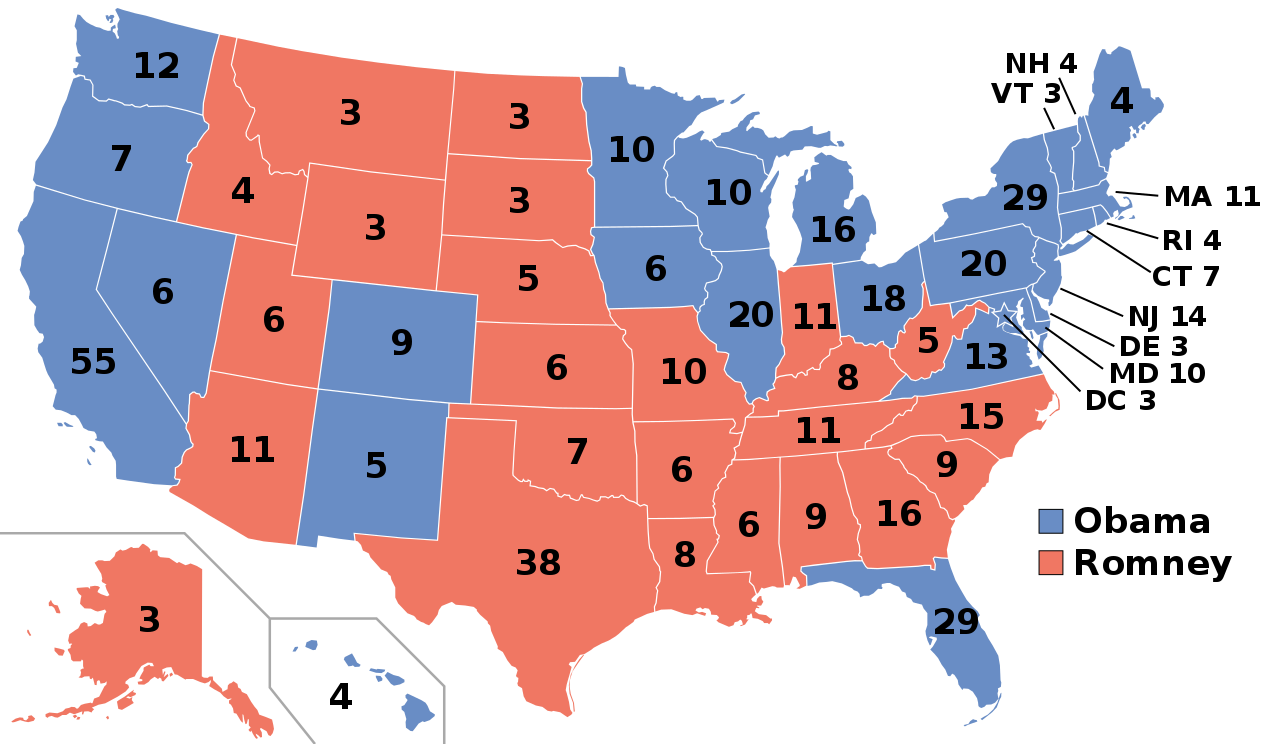
2012 United States presidential election
Presidential elections were held in the United States on November 6, 2012. Incumbent Democratic president Barack Obama and his running mate, incumbent vice president Joe Biden, were elected to a second term. They defeated the Republican ticket of former governor of Massachusetts Mitt Romney and U.S. representative Paul Ryan of Wisconsin.
As the incumbent president, Obama secured the Democratic nomination without serious opposition. The Republicans experienced a competitive primary. Romney was consistently competitive in the polls and won the support of many party leaders, but he faced challenges from a number of more conservative contenders. Romney secured his party's nomination in May, defeating former senator Rick Santorum, former speaker of the House and Georgia congressman Newt Gingrich, and Texas congressman Ron Paul, among other candidates.
The campaigns focused heavily on domestic issues, and debate centered largely around sound responses to the Great Recession along with long-term federal budget issues, the future of social insurance programs, and the Affordable Care Act. Foreign policy was also discussed, including the end of the Iraq War in 2011, military spending, the Iranian nuclear program, and appropriate counteractions to terrorism. Romney claimed Obama's domestic policies were ineffective and financially insolvent while Obama's campaign sought to characterize Romney as a plutocratic businessman who was out of touch with the average American. The campaign was marked by a sharp rise in fundraising, including from nominally independent Super PACs.
Obama defeated Romney, winning 332 Electoral College votes and 51.1% of the popular vote to Romney's 206 electoral votes and 47.2% of the popular vote. He became the third sitting president in a row (after Bill Clinton and George W. Bush) to win a second consecutive term. Obama carried all 18 "blue wall" states and defeated Romney in crucial swing states that Republicans had previously won in 2000 and 2004, namely Colorado, Florida, Nevada, Ohio, and Virginia. Despite his loss, Romney managed to flip Indiana, North Carolina, and Nebraska's 2nd congressional district from the 2008 election. Ultimately, Obama won eight of the nine main swing states, losing only North Carolina.
As of 2026, this is the most recent presidential election in which the Democratic candidate won Iowa, Ohio, and Florida, along with Maine's 2nd congressional district. This also remains the most recent election in which an incumbent president won re-election to a second consecutive term, in which the incumbent presidential party won re-election, and in which the Democratic ticket did not include a woman. It is also the most recent presidential election in which the party that won the presidency did not also win control of both chambers of Congress, as well as the earliest presidential election in which all major party nominees for president and vice-president are still alive.
Background
State changes to voter registration and electoral rules
In 2011, several state legislatures passed new voting laws, especially pertaining to voter identification, with the stated purpose of combating voter fraud; however, the laws were attacked by the Democratic Party as attempts to suppress voting among its supporters and to improve the Republican Party's presidential prospects. Florida, Georgia, Ohio, Tennessee, and West Virginia's state legislatures approved measures to shorten early voting periods. Florida and Iowa barred all felons from voting. Kansas, South Carolina, Tennessee, Texas, and Wisconsin state legislatures passed laws requiring voters to have government-issued IDs before they could cast their ballots. This meant typically that people without driver's licenses or passports had to gain new forms of ID. Former president Bill Clinton denounced them, saying, "There has never been in my lifetime, since we got rid of the poll tax and all the Jim Crow burdens on voting, the determined effort to limit the franchise that we see today". He was referring to Jim Crow laws passed in southern states near the turn of the twentieth century that disenfranchised most blacks from voting and excluded them from the political process for more than six decades. Clinton said the moves would effectively disenfranchise core voter blocs that trend liberal, including college students, black people, and Latinos.
The Obama campaign fought against the Ohio law, pushing for a petition and statewide referendum to repeal it in time for the 2012 election. In addition, the Pennsylvania legislature proposed a plan to change its representation in the electoral college from the traditional winner-take-all model to a district-by-district model. As the governorship and both houses of its legislature were Republican-controlled, the move was viewed by some as an attempt to reduce Democratic chances. Ultimately, they did not do it, leaving their winner take all format intact as of 2020.
Nominations
Democratic Party
Primaries
With an incumbent president running for re-election against token opposition, the race for the Democratic nomination was largely uneventful. The nomination process consisted of primaries and caucuses, held by the 50 states, as well as Guam, Puerto Rico, Washington, D.C., U.S. Virgin Islands, American Samoa, and Democrats Abroad. Additionally, high-ranking party members known as superdelegates each received one vote in the convention. A few of the primary challengers surpassed the president's vote total in individual counties in several of the seven contested primaries, though none made a significant impact in the delegate count. Running unopposed everywhere else, Obama cemented his status as the Democratic presumptive nominee on April 3, 2012, by securing the minimum number of pledged delegates needed to obtain the nomination.
Candidate
Republican Party
Primaries
Candidates with considerable name recognition who entered the race for the Republican presidential nomination in the early stages of the primary campaign included U.S. representative and former Libertarian nominee Ron Paul, former Minnesota governor Tim Pawlenty, who co-chaired John McCain's campaign in 2008, former Massachusetts governor Mitt Romney, the runner-up for the nomination in the 2008 cycle, and former Speaker of the House Newt Gingrich.
The first debate took place on May 5, 2011, in Greenville, South Carolina, with businessman Herman Cain, former New Mexico governor Gary Johnson, Ron Paul, Tim Pawlenty, and former Pennsylvania senator Rick Santorum participating. Another debate took place a month later, with Newt Gingrich, Mitt Romney, former Utah governor Jon Huntsman, and Minnesota congresswoman Michele Bachmann participating, and Gary Johnson excluded. A total of thirteen debates were held before the Iowa caucuses.
The first major event of the campaign was the Ames Straw Poll, which took place in Iowa on August 13, 2011. Michele Bachmann won the straw poll (this ultimately proved to be the acme of her campaign). Pawlenty withdrew from the race after a poor showing in the straw poll, as did Thaddeus McCotter, the only candidate among those who qualified for the ballot who was refused entrance into the debate.
It became clear at around this point in the nomination process that while Romney was considered to be the likely nominee by the Republican establishment, a large segment of the conservative primary electorate found him to be too moderate for their political views. As a result, a number of potential "anti-Romney" candidates were put forward, including future president Donald Trump, former Alaska governor and 2008 vice-presidential nominee Sarah Palin, New Jersey governor Chris Christie, and Texas governor Rick Perry, the last of whom decided to run in August 2011. Perry did poorly in the debates, however, and Herman Cain and then Newt Gingrich came to the fore in October and November.
Due to a number of scandals, Cain withdrew just before the end of the year, after having ballot placement in several states. Around the same time, Johnson, who had been able to get into only one other debate, withdrew to seek the Libertarian Party nomination.
For the first time in modern Republican Party history, three different candidates won the first three state contests in January (the Iowa caucuses, the New Hampshire primary, and the South Carolina primary). Although Romney had been expected to win in at least Iowa and New Hampshire, Rick Santorum won the non-binding poll at caucus sites in Iowa by 34 votes, as near as could be determined from the incomplete tally, earning him a declaration as winner by state party leaders, although vote totals were missing from eight precincts. The election of county delegates at the caucuses would eventually lead to Ron Paul earning 22 of the 28 Iowa delegates to the Republican National Convention. Newt Gingrich won South Carolina by a surprisingly large margin, and Romney won only in New Hampshire.
A number of candidates dropped out at this point in the nomination process. Bachmann withdrew after finishing sixth in the Iowa caucuses, Huntsman withdrew after coming in third in New Hampshire, and Perry withdrew when polls showed him drawing low numbers in South Carolina.
Content sourced from Wikipedia under CC BY-SA 4.0


