2004 Indian Ocean earthquake and tsunami
On 26 December 2004, at 07:58:53 local time (UTC+7), a Mw 9.2–9.3 earthquake struck with its epicenter off the west coast of Aceh, in northern Sumatra, Indonesia. The undersea megathrust earthquake, known in the scientific community as the Sumatra–Andaman earthquake, was caused by a rupture along the fault boundary between the Burma plate and the Indian plate, and reached a maximum Mercalli intensity of IX in some areas.
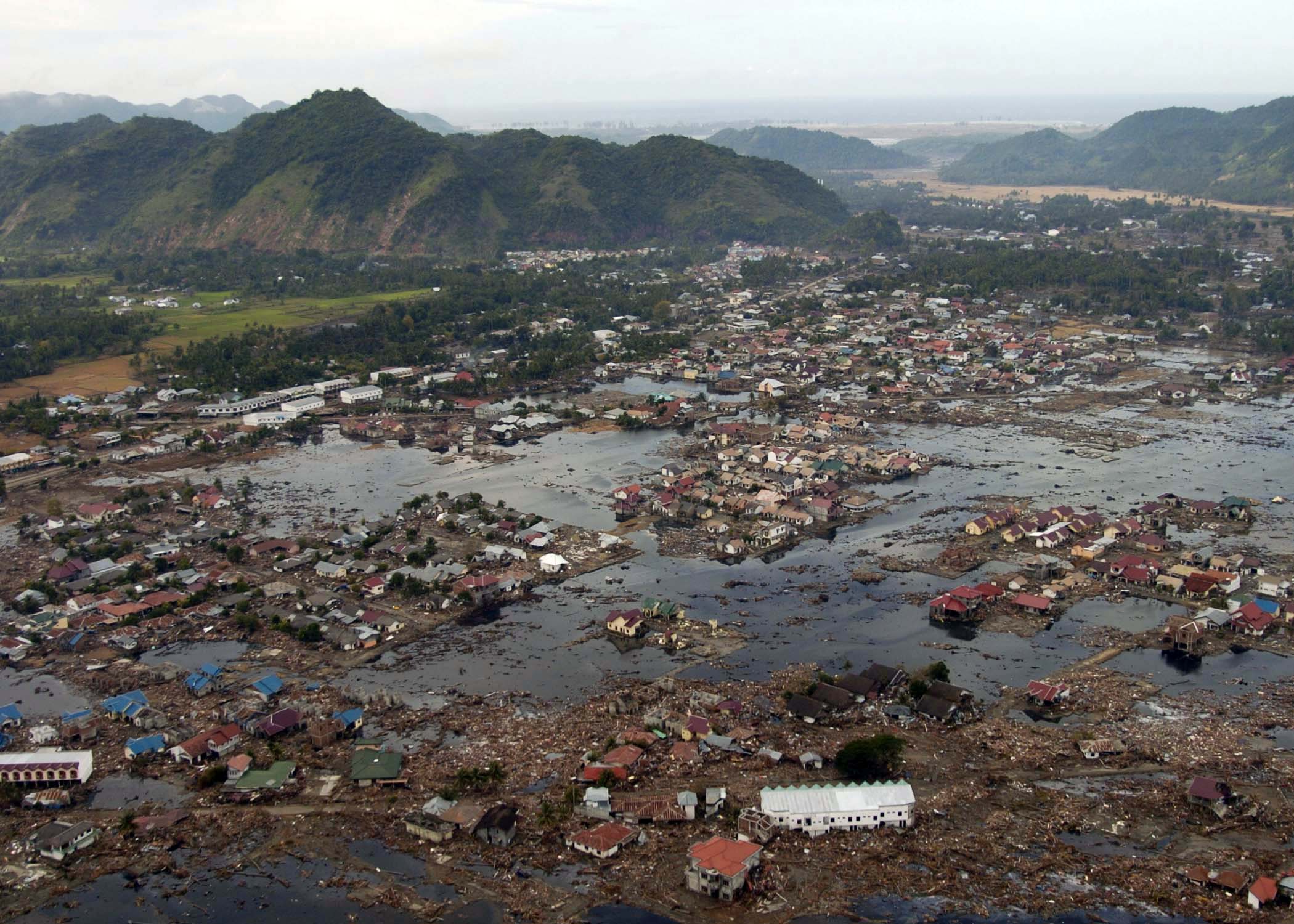
The earthquake caused a massive tsunami with waves up to 30 m (100 ft) high, commonly referred to as the Boxing Day tsunami, after the Boxing Day holiday, or the Asian tsunami, which devastated communities along the surrounding coasts of the Indian Ocean, killing an estimated 227,898 people in 14 countries, especially in Aceh (Indonesia), Sri Lanka, Tamil Nadu in India, and Khao Lak in Thailand. The direct result was severe disruption to living conditions and commerce in coastal provinces of these and other surrounding countries. It is the deadliest tsunami in history, the deadliest natural disaster of the 21st century, and one of the deadliest natural disasters in recorded history. It is also the worst natural disaster in the history of Indonesia, the Maldives, Sri Lanka, and Thailand.
The earthquake itself is the most powerful earthquake ever recorded in Asia, the strongest of the 21st century, and the second- or third-most powerful globally since modern seismography began in 1900. It had the longest fault rupture ever observed, between 1,200 to 1,300 kilometres (746 to 808 mi), and had the longest duration of faulting ever observed, lasting at least ten minutes. It caused the entire planet to vibrate by as much as 10 mm (0.4 in), and also remotely triggered earthquakes as far away as Alaska. Its epicentre was located between Simeulue and mainland Sumatra. The plight of the affected people and countries prompted a worldwide humanitarian response, with donations totaling more than US$14 billion (equivalent to US$24 billion in 2025 currency).
Earthquake
The 2004 Indian Ocean earthquake was initially documented as having a moment magnitude of 8.8. The United States Geological Survey has its official estimate of Mw 9.1, but most recent studies suggest that the earthquake was Mw 9.2–9.3. Hiroo Kanamori of the California Institute of Technology estimates that Mw 9.2 is the most representative estimate of the earthquake's size. More recent studies estimate the magnitude to be Mw 9.3. A 2016 study estimated the magnitude to be Mw 9.25, while a 2021 study revised its 2007 estimate of Mw 9.1 to a new magnitude of Mw 9.2.
The hypocentre of the main earthquake was approximately 160 km (100 mi) off the western coast of northern Sumatra, in the Indian Ocean just north of Simeulue island at a depth of 30 km (19 mi) below sea level (initially reported as 10 km or 6.2 mi). The northern section of the Sunda megathrust ruptured over a length of 1,300 km (810 mi). The earthquake (followed by the tsunami) was felt in Bangladesh, India, Malaysia, Myanmar, Thailand, Sri Lanka and the Maldives. Splay faults, or secondary "pop up faults", caused long, narrow parts of the seafloor to pop up in seconds. This rapidly increased the height and speed of the tsunami waves, destroying the nearby Indonesian town of Lhoknga.
Indonesia lies between the Pacific Ring of Fire along the northeastern islands adjacent to New Guinea, and the Alpide belt that runs along the south and west from Sumatra, Java, Bali, Flores to Timor. The 2002 Sumatra earthquake is believed to have been a foreshock, preceding the main event by over two years.
Historical comparisons
Great earthquakes such as the 2004 Indian Ocean earthquake are generally associated with megathrust events in subduction zones. Their seismic moments can account for a significant fraction of the global seismic moment across century-scale periods. Of all the moment released by earthquakes in the 100 years from 1906 through 2005, roughly one-eighth was due to the 2004 Indian Ocean earthquake. This quake, together with the Great Alaskan earthquake (1964) and the Great Chilean earthquake (1960), account for almost half of the total moment.
Since 1900, the only earthquakes recorded with a greater magnitude were the 1960 Chile earthquake (magnitude 9.5) and the 1964 Alaska earthquake in Prince William Sound (magnitude 9.2). The only other recorded earthquakes of magnitude 9.0 or greater were off Kamchatka, Russia, on 5 November 1952 (magnitude 9.0) and Tōhoku, Japan (magnitude 9.1) in March 2011. Each of these megathrust earthquakes also spawned tsunamis in the Pacific Ocean. In comparison to the 2004 Indian Ocean earthquake, the death toll from these earthquakes and tsunamis was significantly lower, primarily because of the lower population density along the coasts near affected areas.
Comparisons with earlier earthquakes are difficult, as earthquake strength was not measured systematically until the 1930s. However, historical earthquake strength can sometimes be estimated by examining historical descriptions of the damage caused, and the geological records of the areas where they occurred. Some examples of significant historical megathrust earthquakes are the 1868 Arica earthquake in Peru and the 1700 Cascadia earthquake in western North America.
Tectonic plates
The 2004 Indian Ocean earthquake was unusually large in geographical and geological extent. An estimated 1,600 km (1,000 mi) of fault surface slipped (or ruptured) about 15 m (50 ft) along the subduction zone where the Indian plate slides under (or subducts) the overriding Burma plate. The slip did not happen instantaneously but took place in two phases over several minutes: Seismographic and acoustic data indicate that the first phase involved a rupture about 400 km (250 mi) long and 100 km (60 mi) wide, 30 km (19 mi) beneath the sea bed—the largest rupture ever known to have been caused by an earthquake. The rupture proceeded at about 2.8 km/s (1.74 mi/s; 10,100 km/h; 6,260 mph), beginning off the coast of Aceh and proceeding north-westerly over about 100 seconds. After a pause of about another 100 seconds, the rupture continued northwards towards the Andaman and Nicobar Islands. The northern rupture occurred more slowly than in the south, at about 2.1 km/s (1.3 mi/s; 7,600 km/h; 4,700 mph), continuing north for another five minutes to a plate boundary where the fault type changes from subduction to strike-slip (the two plates slide past one another in opposite directions).
The Indian plate is part of the Indo-Australian plate, which underlies the Indian Ocean and Bay of Bengal, and is moving north-east at an average of 60 mm/a (0.075 in/Ms). The India Plate meets the Burma plate (which is considered a portion of the great Eurasian plate) at the Sunda Trench. At this point, the India Plate subducts beneath the Burma plate, which carries the Nicobar Islands, the Andaman Islands, and northern Sumatra. The India Plate sinks deeper and deeper beneath the Burma plate until the increasing temperature and pressure drive volatiles out of the subducting plate. These volatiles rise into the overlying plate, causing partial melting and the formation of magma. The rising magma intrudes into the crust above and exits the Earth's crust through volcanoes in the form of a volcanic arc. The volcanic activity that results as the Indo-Australian plate subducts the Eurasian plate has created the Sunda Arc.
As well as the sideways movement between the plates, the 2004 Indian Ocean earthquake resulted in a rise of the seafloor by several metres, displacing an estimated 30 km3 (7.2 cu mi) of water and triggering devastating tsunami waves. The waves radiated outwards along the entire 1,600 km (1,000 mi) length of the rupture (acting as a line source). This greatly increased the geographical area over which the waves were observed, reaching as far as Mexico, Chile, and the Arctic. The raising of the seafloor significantly reduced the capacity of the Indian Ocean, producing a permanent rise in the global sea level by an estimated 0.1 mm (0.004 in).
Aftershocks and other earthquakes
Numerous aftershocks were reported off the Andaman Islands, the Nicobar Islands and the region of the original epicentre in the hours and days that followed. The magnitude 8.6 2005 Nias–Simeulue earthquake, which originated off the coast of the Sumatran island of Nias, is not considered an aftershock, despite its proximity to the epicentre, and was most likely triggered by stress changes associated with the 2004 event. The earthquake produced its own aftershocks (some registering a magnitude of as high as 6.9.
Other aftershocks of up to magnitude 7.2 continued to shake the region daily for three or four months. As well as continuing aftershocks, the energy released by the original earthquake continued to make its presence felt well after the event. A week after the earthquake, its reverberations could still be measured, providing valuable scientific data about the Earth's interior.
The 2004 Indian Ocean earthquake came just three days after a magnitude 8.1 earthquake in the sub-antarctic Auckland Islands, an uninhabited region west of New Zealand, and Macquarie Island to Australia's south. This is unusual since earthquakes of magnitude eight or more occur only about once per year on average. The U.S. Geological Survey sees no evidence of a causal relationship between these events.
Content sourced from Wikipedia under CC BY-SA 4.0


