1989 Tiananmen Square protests and massacre
Student-led demonstrations in China
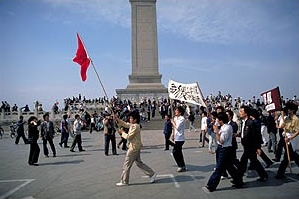
Protests led by students, known in China as the June Fourth Incident, were held in Tiananmen Square in Beijing, China, from 15 April to 4 June 1989. After weeks of unsuccessful attempts between the demonstrators and the Chinese government to find a peaceful resolution, the Chinese government deployed troops to occupy the square on the night of 3 June in what is referred to as the Tiananmen Square massacre. The events are sometimes called the '89 Democracy Movement, the Tiananmen Square Incident, or the Tiananmen uprising.
The protests were initiated by the death of pro-reform Chinese Communist Party (CCP) general secretary Hu Yaobang in April 1989, amid the backdrop of rapid economic development and social change in post-Mao China, reflecting anxieties among the people and political elite about the country's future. Common grievances at the time included inflation, corruption, limited preparedness of graduates for the new economy, and restrictions on political participation. Although they were highly disorganised and their goals varied, the students called for things like the rollback of the removal of iron rice bowl jobs, greater accountability, constitutional due process, democracy, freedom of the press, and freedom of speech. Workers' protests were generally focused on inflation and the erosion of welfare. These groups united around anti-corruption demands, adjusting economic policies, and protecting social security. At the height of the protests on May 17, about one million people assembled in the square.
As the protests developed, Chinese authorities responded with both conciliatory and hardline tactics, exposing deep divisions within the party leadership. By May, a student-led hunger strike galvanised support around the country for the demonstrators, and the protests spread to some 400 cities.
On 20 May, the State Council declared martial law, and as many as 300,000 troops were mobilized to Beijing. After several weeks of standoffs and confrontations between the army and demonstrators, a meeting held among the CCP's top leadership on 1 June concluded with a decision to clear the square. The troops advanced into central parts of Beijing on the city's major thoroughfares in the early morning hours of 4 June and engaged in bloody clashes with demonstrators attempting to block them, in which many people – demonstrators, bystanders, and soldiers – were killed. The vast majority of killings were clustered in Beijing's western suburbs along the Chang'an Avenue. Estimates of the death toll vary from several hundreds to thousands, with thousands more wounded.
The event had both short and long term consequences. Western countries imposed arm embargoes on China and various Western media outlets labeled the crackdown a "massacre". In the aftermath of the protests, the Chinese government suppressed other protests around China, carried out mass arrests of protesters which catalysed Operation Yellowbird, strictly controlled coverage of the events in the domestic and foreign affiliated press, and demoted or purged officials it deemed sympathetic to the protests. The government also invested heavily into creating more effective police riot control units. More broadly, the suppression ended the political reforms which began in 1986 as well as the New Enlightenment movement, and halted the policies of liberalisation of the 1980s, which were only partly resumed after Deng Xiaoping's southern tour in 1992.
Considered a watershed event, reactions to the protests set limits on political expression in China that have lasted up to the present day. The events remain one of the most sensitive and most widely censored topics in China.
Naming
The Chinese government has used numerous names for the event since 1989. As the events unfolded, it was labeled a "counter revolutionary rebellion", which was later changed to simply "riot", followed by "political turmoil" and "1989 storm".
Outside mainland China, and among circles critical of the crackdown within mainland China, the crackdown is commonly referred to in Chinese as "June Fourth Massacre" (六四屠殺; liù-sì túshā) and "June Fourth Crackdown" (六四鎮壓; liù-sì zhènyā). To bypass censorship by the Great Firewall, alternative names have sprung up to describe the events on the Internet, such as May 35th, VIIV (Roman numerals for 6 and 4), Eight Squared (since 82=64) and 8964 (in yymd format).
In English, the terms "Tiananmen Square Massacre", "Tiananmen Square Protests", and "Tiananmen Square Crackdown" are often used to describe the series of events. However, much of the violence in Beijing did not actually happen in Tiananmen, but outside the square along a stretch of Chang'an Avenue only a few miles long, and especially near the Muxidi area. The term also gives a misleading impression that demonstrations only happened in Beijing, when in fact, they occurred in many cities throughout China.
Background
Boluan Fanzheng and economic reforms
The Cultural Revolution ended with chairman Mao Zedong's death in 1976 and the arrest of the Gang of Four. The movement, spearheaded by Mao, had caused severe damage to the country's initially diverse economic and social fabric. As a result, the country was now mired in poverty as economic production slowed or came to a halt.
Deng Xiaoping proposed the idea of Boluan Fanzheng ("bringing order out of chaos") to correct the mistakes of the Cultural Revolution. He launched a comprehensive program to reform the Chinese economy called the reform and opening up. Within several years, the country's focus on ideological purity was replaced by a concerted attempt to achieve material prosperity. To oversee his reform agenda, Deng promoted his allies to top government and party posts. Zhao Ziyang was named Premier, the head of government, in September 1980, and Hu Yaobang became CCP General Secretary in 1982.
Challenges to Reforms and Opening up
Deng's reforms aimed to decrease the state's role in the economy and gradually allow private production in agriculture and industry. By 1981, roughly 73% of rural farms had been de-collectivized, and 80% of state-owned enterprises were permitted to retain their profits.
While the reforms were generally well received by the public, concerns grew over a series of social problems which the changes brought about, including corruption and nepotism on the part of elite party bureaucrats. The state-mandated pricing system, in place since the 1950s, had long kept prices fixed at low levels. The initial reforms created a two-tier system where some prices were fixed while others were allowed to fluctuate. In a market with chronic shortages, price fluctuation allowed people with powerful connections to buy goods at low prices and sell at market prices. Party bureaucrats in charge of economic management had enormous incentives to engage in such arbitrage. Discontent over corruption reached a fever pitch with the public; and many, particularly intellectuals, began to believe that only democratic reform and the rule of law could cure the country's ills.
Following the 1988 meeting at their summer retreat of Beidaihe, the party leadership under Deng agreed to implement a transition to a market-based pricing system. News of the relaxation of price controls triggered waves of cash withdrawals, buying, and hoarding all over China. The government panicked and rescinded the price reforms in less than two weeks, but there was a pronounced impact for much longer. Inflation soared; official indices reported that the Consumer Price Index increased by 30% in Beijing between 1987 and 1988, leading to panic among salaried workers that they could no longer afford staple goods. Moreover, in the new market economy, unprofitable state-owned enterprises were pressured to cut costs. This threatened a vast proportion of the population that relied on the "iron rice bowl", and instilled fear of potential layoffs coined in Chinese as "xiagang" (下岗), which would imply the loss of social benefits such as job security, medical care, and subsidised housing.
Content sourced from Wikipedia under CC BY-SA 4.0


