Ötzi
Natural mummy of a man
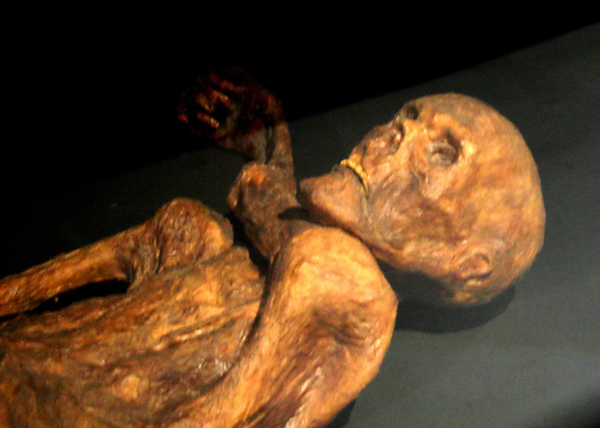
Ötzi, also called The Iceman, Similaun man, or Tyrolean Iceman, is the natural mummy of a man who lived between 3350 and 3105 BC. Ötzi's remains were discovered on 19 September 1991, in the Ötztal Alps (hence the nickname "Ötzi", German: [œtsi]) at the Austria–Italy border. He is Europe's oldest known natural human mummy, offering an unprecedented view of Chalcolithic (Copper Age) Europeans.
Because of the presence of an arrowhead embedded in his left shoulder and various other wounds, researchers believe that Ötzi was killed by another person. The nature of his life and the circumstances of his death are the subject of much investigation and speculation. His remains and personal belongings are on exhibit at the South Tyrol Museum of Archaeology in Bolzano, South Tyrol, Italy.
Discovery
Ötzi was found on 19 September 1991 by two German tourists, at an elevation of 3,210 m (10,530 ft) on the east ridge of the Fineilspitze in the Ötztal Alps on the Austrian–Italian border, near Similaun mountain and the Tisenjoch pass. When the tourists, Helmut and Erika Simon, first saw the body, they both believed that they had happened upon a recently deceased mountaineer. The next day, a mountain gendarme and the keeper of the nearby Similaunhütte first attempted to remove the body, which was frozen in ice below the torso, using a pneumatic drill and ice axes, but bad weather forced them to give up. Within a short time, eight groups visited the site, among whom were mountaineers Hans Kammerlander and Reinhold Messner.
The body was extracted on 22 September and salvaged the following day. It was transported to the office of the medical examiner in Innsbruck, together with other objects found nearby. On 24 September, the find was examined there by archaeologist Konrad Spindler of the University of Innsbruck. He dated the find to be "at least four thousand years old" on the basis of the typology of an axe among the retrieved objects. Tissue samples from the corpse and other accompanying materials were later analyzed at several scientific institutions and their results unequivocally concluded that the remains belonged to someone who had lived between 3359 and 3105 BC, or some 5,000 years ago. More specific estimates find that there was a 66% chance he died between 3239 and 3105 BC, a 33% chance he died between 3359 and 3294 BC, and a 1% chance he died between 3277 and 3268 BC.
In the course of recovery attempts and subsequent handling, multiple mishaps occurred. The mummy and its belongings were prodded with ski poles and ice picks, and the hip area of the body was damaged when the pneumatic drill was used in the initial attempts to remove him. Ötzi's longbow was snapped during this attempt as well, with its bottom part recovered from the ice a year later. Careless handling of the body resulted in the destruction of many elements of the clothing Ötzi was wearing at the time of his death. The mummy's left arm was broken while the body was being forced into a coffin for transportation from Vent to Innsbruck. Fungus began growing on the Iceman's skin while the body was on the mortuary slab in Innsbruck. It was only after five days that scientists initiated a rigorous effort to stabilize the mummy's condition.
Border dispute
At the Treaty of Saint-Germain-en-Laye of 1919, the border between North and South Tyrol was defined as the watershed of the rivers Inn and Etsch. Near Tisenjoch, the glacier (which has since retreated) complicated establishing the watershed and the border was drawn too far north. Although Ötzi's find site drains to the Austrian side, land surveys in October 1991 ultimately proved that the body had been located 92.56 m (101.22 yd) inside Italian territory, which was in consonance with Italy's original 1919 ownership claim.
The province of South Tyrol claimed property rights but agreed to let Innsbruck University finish its scientific examinations. Since 1998, he has been on display at the South Tyrol Museum of Archaeology in Bolzano, the capital of South Tyrol.
Scientific analyses
The corpse has been extensively examined, measured, X-rayed, and dated. Tissues and intestinal contents have been examined microscopically, as have the items found with the body. In August 2004, the frozen bodies of three Austro-Hungarian soldiers killed during the Battle of San Matteo (1918) were found on the mountain Punta San Matteo in Trentino. One body was sent to a museum in the hope that research on how the environment had affected its preservation would help unravel Ötzi's past.
Body
By the most recent estimates, at the time of his death, Ötzi was 160 cm (5 ft 3 in) tall, weighed about 50 kg (110 lb), and was about 45 years of age. When his body was found, it weighed 13.750 kg (30 lb 5.0 oz). Because the body was covered in ice shortly after his death, it had only partially deteriorated. Initial reports claimed that his penis and most of his scrotum were missing, but this was later shown to be unfounded. Analysis of pollen, dust grains and the isotopic composition of his tooth enamel indicates that he spent his childhood near what is now the South Tyrol village of Feldthurns, north of Bolzano, but later went to live in valleys about 50 kilometres (31 mi) farther north.
In 2009, a CAT scan revealed that the stomach had shifted upward to where his lower lung area would normally be. Analysis of the contents revealed the partly digested remains of ibex meat, confirmed by DNA analysis, suggesting he had had a meal less than two hours before his death. Wheat grains were also found. It is believed that he most likely had a few slices of a dried, fatty meat, which came from a wild goat in South Tyrol, Italy. Analysis of his intestinal contents showed two meals (the last one consumed about eight hours before his death), one of chamois meat, the other of red deer and herb bread; both were eaten with roots and fruits. The grain also eaten with both meals was a highly processed einkorn wheat bran, possibly bread. In the proximity of the body, and thus possibly originating from the Iceman's provisions, chaff and grains of einkorn and barley, and seeds of flax and poppy were discovered, as well as kernels of sloes (small plum-like fruits of the blackthorn tree) and various wild berry seeds.
Hair analysis was used to examine his diet in the months preceding his death. Pollen in the first meal showed that it had been consumed in a mid-altitude conifer forest. Other pollens indicated the presence of wheat and legumes, which may have been domesticated crops. Pollen grains of hop-hornbeam were also discovered. The pollen was very well preserved, with the cells inside remaining intact, indicating that it had been fresh (estimated about two hours old) at the time of Ötzi's death, which places the event in the spring or early summer. Einkorn wheat is harvested in the late summer, and sloes in the autumn; these must have been stored from the previous year.
High levels of copper and arsenic were found in his hair. This, along with his copper axe blade, which is 99.7% copper, has led scientists to speculate that he was involved in copper smelting.
By examining the proportions of his tibia, femur and pelvis, it was postulated that his lifestyle included long walks over hilly terrain. This degree of mobility is not characteristic of other Copper Age Europeans. This may indicate that he was a high-altitude shepherd.
Using modern 3D scanning technology, a facial reconstruction has been created for the South Tyrol Museum of Archaeology. It shows the Iceman looking old for his 45 years, with deep-set brown eyes, a beard, a furrowed face, and sunken cheeks. He is depicted as tired and ungroomed.
Health
Ötzi had Trichuris trichiura (whipworm), an intestinal parasite. During CT scans, it was observed that three or four of his right ribs had been cracked when he had been lying face down after death, or where the ice had crushed his body. One of his fingernails (of the two found) shows three Beau's lines, indicating he was sick three times in the six months before he died. The last incident, two months before he died, lasted about two weeks. It was also found that his epidermis, the outer skin layer, was missing, a natural process from his mummification in ice. Ötzi's teeth showed considerable internal deterioration from cavities. These oral pathologies may have been brought about by his grain-heavy, high-carbohydrate diet. DNA analysis in February 2012 revealed that Ötzi was lactose intolerant, supporting the theory that lactose intolerance was still common at that time, despite the increasing spread of agriculture and dairying. Ötzi's lungs were examined endoscopically and were found to be blackened by soot, probably due to his frequent proximity to open fires for warmth and cooking.
Content sourced from Wikipedia under CC BY-SA 4.0


